
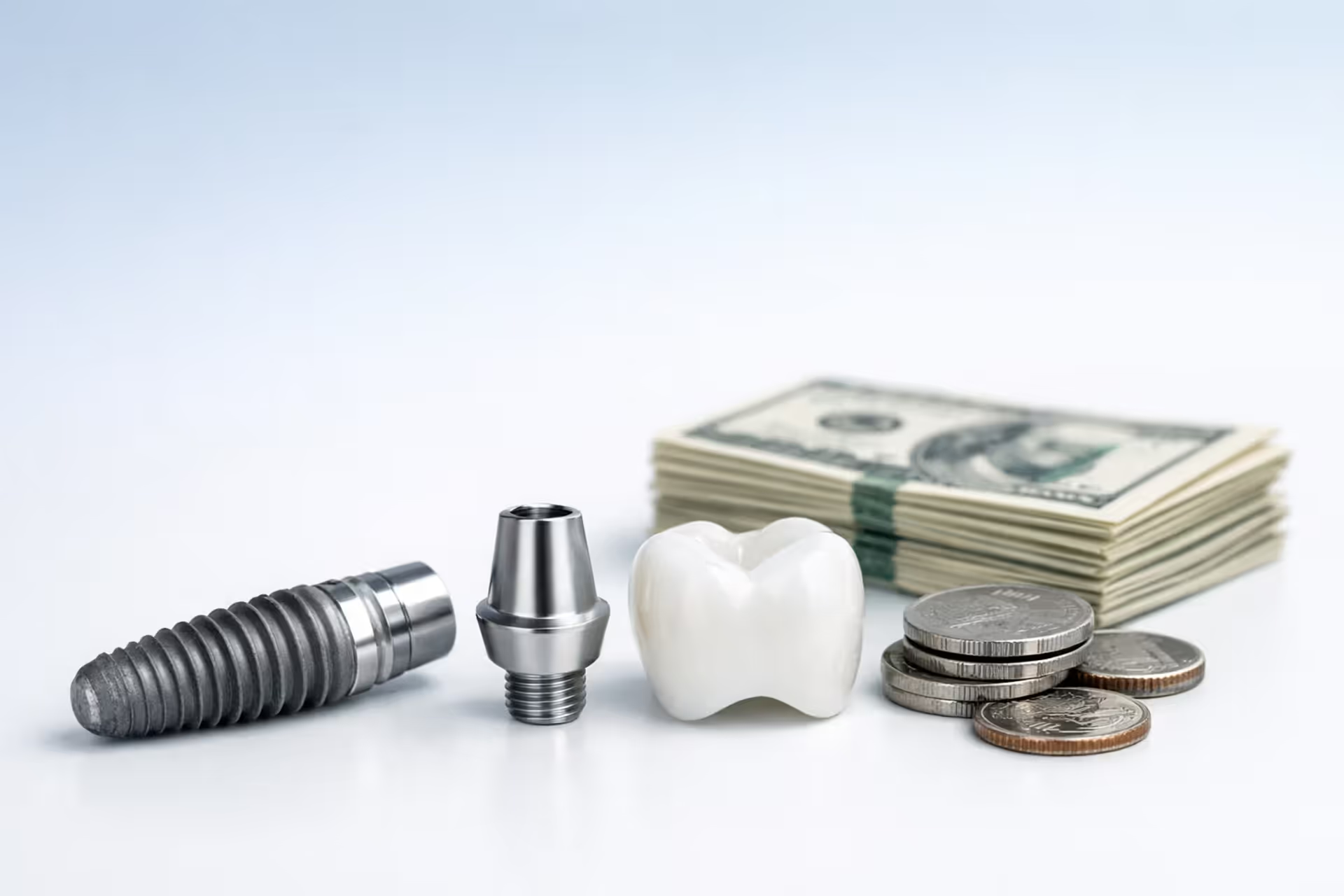
Dental implant components including titanium post abutment and crown placed next to a small stack of US dollar bills on a clean white surface
Dental Insurance That Covers Implants Guide

Your dentist just quoted you $4,800 for an implant. You're wondering if your insurance will help—or if you'll drain your savings account instead.
Here's what nobody tells you upfront: most dental plans treat implants like luxury items, not essential treatment. You've been paying premiums for years, but when you actually need expensive work? That's when you discover the fine print, waiting periods, and coverage caps that leave you holding the bill.
I'm breaking down exactly how implant coverage works, which plans actually pay meaningful amounts, and what to do when insurance falls short. No fluff—just the details that affect your wallet.
Do Dental Insurance Plans Cover Implants?
Let's cut through the confusion right away. Traditional dental plans weren't built for implants. They were designed in the 1970s and 80s when bridges and dentures were the standard solutions.
Only about 10-15% of workplace dental plans provide solid implant coverage in 2026. Most either exclude implants completely or bury them under restrictions that make coverage nearly worthless.
Why? Insurance companies view implants as optional. They'll argue that bridges or dentures solve the same problem for less money. Never mind that implants last 20+ years while bridges need replacement every 10-15 years. Insurers focus on immediate costs, not long-term value.
The medical necessity question creates another roadblock. Lost your tooth in a car accident? Some plans might help. Lost it from a cavity or gum disease? You're probably on your own, even though decay and periodontal problems cause most tooth loss.
Here's a mistake people make constantly: they see "major restorative procedures" in their policy and assume implants are included. That phrase usually means root canals, crowns, and bridges. Nothing more. I've seen dozens of people schedule surgery based on this misunderstanding, then get blindsided by denied claims.
Want to know if your plan actually covers implants? Don't trust the summary brochure. Request the full Schedule of Benefits and look for dental codes D6010 through D6194. These are implant-specific codes. If they're missing or listed under exclusions, you have your answer.

Author: Ashley Whitford;
Source: ladylesliebelize.com
How Dental Implant Insurance Coverage Works
Implants involve three separate components, and insurers may cover each one differently—or not at all.
The titanium post gets surgically placed into your jawbone. This runs $1,500-2,500. Plans categorize it under oral surgery. If your policy covers it (big if), expect 50% reimbursement after you've paid your deductible.
The abutment connects the post to the crown. Costs another $500-1,000. Some insurers bundle this with the crown. Others exclude it entirely. You won't know until you file a pre-authorization.
The crown sits on top where people see it. This part—$1,000-3,000—gets covered most consistently because crowns are standard dental work. Still just 40-50% reimbursement though.
Now here's where it gets frustrating. Even when your plan covers all three parts at 50%, you're not getting half your money back. You're getting 50% of what the insurance company decides the work should cost, which is usually 20-30% below what dentists actually charge. Your dentist bills $5,000. The insurer says "reasonable and customary" cost is $3,500. You receive $1,750 (50% of $3,500), not $2,500.
Then there's the annual maximum—usually $1,500 to $2,000. Hit that ceiling and everything else is your problem. One implant costs $4,000-6,000, so that maximum gets exhausted fast.
Waiting periods present another hassle. Most plans make you wait 6-12 months before covering major work. Some stretch it to two full years for implants specifically. Switch plans during that time? The clock resets. Let your coverage lapse for even one month? Start over.
Smart patients game the system by splitting procedures across benefit years. Get the post placed in December, add the crown in January. Two separate years of maximums = double the reimbursement. Not every dentist's willing to work this way, but it's worth asking.
Types of Dental Insurance Plans That Cover Implants
Plan structure determines whether you'll find implant coverage and how much you'll actually collect.
PPO Plans
PPO networks give you the best shot at partial implant coverage. These plans negotiate with dentists to provide care at specific rates. You'll typically get 50% back on major procedures after paying your deductible (usually $50-100).
The tradeoff? Monthly premiums run $40-70 for individual coverage—higher than other options. You can use dentists outside the network, but reimbursement drops to 40% or lower, and you'll pay the difference between what the dentist charges and what the plan considers "reasonable."
Some PPOs reward loyalty. Stick with them for three years and your major services coverage might increase from 50% to 60%. That's an extra $300-500 toward an implant—not huge, but worth considering if you're planning ahead.

Author: Ashley Whitford;
Source: ladylesliebelize.com
Indemnity Plans
These old-school plans let you visit any dentist without worrying about networks. They pay a percentage based on their fee schedule.
Indemnity coverage rarely excludes procedures outright, making implants more likely to be covered than with HMO-style plans. But here's the catch: their fee schedules are outdated. They might list implants at $2,000 when dentists charge $4,500. You'll get 50% of $2,000 ($1,000), not 50% of what you actually pay.
Monthly premiums run $50-90 for individuals. Deductibles sit higher than PPO plans. You're paying for flexibility, not generosity.
Discount Dental Plans
These aren't insurance—they're membership clubs. You pay an annual fee ($100-250), then get 20-40% off at participating dentists. No claims, no reimbursement, no annual maximums.
A dentist charging $4,000 for an implant might offer it at $2,400-3,200 to plan members. You pay the discounted rate directly at the appointment.
Downsides? Limited provider networks in some areas. No guarantee of quality. Some dentists make up for the discount by pushing additional procedures you don't need. And unlike insurance, these plans don't count toward your out-of-pocket maximum if you have other health coverage.
Medicare Advantage Plans
Traditional Medicare won't touch dental implants. Medicare Advantage plans (Part C) sometimes include dental benefits, but don't get excited yet.
Most Advantage plans with dental coverage provide just $1,000-2,000 total for all dental work per year. That barely covers a cleaning and a couple fillings, let alone a $5,000 implant. A few specialized plans stretch to $3,000 annually, but premiums and other healthcare costs often cancel out the benefit.
Use Medicare Advantage dental for preventive care—cleanings, X-rays, occasional fillings. For implants, you'll need another strategy.
Does Any Dental Insurance Cover Implants Immediately?
Author: Ashley Whitford;
Source: ladylesliebelize.com
Short answer: almost none, and the ones that do have major strings attached.
Employer group plans purchased during open enrollment sometimes waive waiting periods. If your company offers this, consider yourself lucky. But verify the specific language—some plans waive waiting periods for fillings and crowns while maintaining them for implants.
A few individual plans advertise "no waiting period" but accomplish this through tricks: annual maximums so low ($750-1,000) they're useless for implants, sky-high premiums that offset the insurer's risk, or reimbursement rates that barely cover 20% of actual costs.
One legitimate scenario for immediate coverage: dental injuries from accidents. Some medical insurance policies cover emergency dental work from accidents under your medical benefits, completely bypassing dental insurance. This only applies to the immediate injury though—not the elective implant you get six months later.
Why do waiting periods exist? To prevent people from buying insurance only when they need expensive work, then canceling after treatment. Insurers would lose money on every policy. Waiting periods protect their business model at your expense.
What Percentage of Implant Costs Does Insurance Typically Cover?
Standard plans cover major services at 50%, but don't let that fool you. It doesn't mean half your bill.
It means 50% of what the insurance company thinks the procedure should cost. Your dentist charges $5,000. The insurer's fee schedule says $3,500 is "reasonable." You get $1,750 (50% of $3,500), not $2,500. That gap comes from your pocket.
Annual maximums create an even bigger problem. Even if your math says 50% of $6,000 equals $3,000 reimbursement, you'll only receive your plan's maximum—typically $1,500-2,000. The percentage becomes meaningless once you hit that cap.
Plans claiming to cover implants at 100% are selling fantasy. Look closer and you'll find they mean 100% of a predetermined amount—maybe $1,000—which covers maybe one-fifth of the actual cost.
The closest thing to full coverage? High-end executive or union plans with $3,000-5,000 annual maximums and 80% reimbursement. These cost $100-200 monthly and usually only come through employer groups. Even then, you're paying $1,200-2,400 yearly in premiums for benefits you might not use.
Reality check: plan to pay 60-80% out of pocket even with decent insurance. That $4,500 implant might yield $750-1,500 from insurance, leaving you responsible for $3,000-3,750.
How to Find Insurance That Covers Dental Implants
Shopping for implant coverage takes more work than comparing premiums. Here's how to find plans that deliver actual value:
Get the full Schedule of Benefits and Exclusions. Don't trust sales reps or summary brochures. You need the document listing covered procedures by dental code. Search for codes D6010 (surgical implant placement), D6056-D6067 (abutments), and D6058-D6194 (implant crowns). If these codes show up with a percentage, the plan covers implants. If they're listed under exclusions, walk away.
Calculate real-world benefits, not advertised percentages. A plan covering 50% of implants with a $1,000 maximum delivers less than a plan covering 40% with a $2,500 maximum. Multiply coverage percentage by annual maximum—that's your realistic reimbursement ceiling.
Ask about waiting period workarounds. Some plans waive waiting periods if you're switching from another dental policy without a gap in coverage. Others offer this for new employees joining during open enrollment. One phone call could save you 12 months of waiting.
Verify network restrictions before buying. PPO plans often require specific oral surgeons or periodontists in their network for implant work. Already consulted with a specialist you trust? Make sure they're in-network or you'll lose 10-20% of your reimbursement.
Calculate three-year total costs. Add premiums, deductibles, and estimated out-of-pocket expenses over three years (including waiting periods). Sometimes paying cash and skipping insurance entirely costs less than years of premiums for minimal benefits.
Check definitions of medical necessity. Plans cover implants more generously when tooth loss resulted from accidents, cancer treatment, or congenital absence. If your situation fits, you might get better coverage than standard major services rates.
Your dentist's office manager knows which local plans actually pay claims versus which ones create headaches. They can't legally recommend specific companies, but they can tell you which plans their other patients have had success with. That insider knowledge beats any sales pitch.
Alternatives If Your Insurance Won't Cover Implants
When insurance disappoints (which it usually does), these options make implants more affordable:

Author: Ashley Whitford;
Source: ladylesliebelize.com
Dental savings plans provide immediate discounted rates—no waiting periods required. Programs like Careington, DentalPlans.com, and Cigna Dental Savings cut implant costs 20-40%. Pay $100-250 annually for membership, then receive reduced rates at participating dentists. Works perfectly if you need treatment now and can't sit through insurance waiting periods.
Health Savings Accounts and Flexible Spending Accounts let you pay with pre-tax dollars, effectively discounting your cost by your tax rate. In the 24% tax bracket, a $4,000 implant costs $3,040 in after-tax dollars when paid through an HSA. Max out contributions ($4,300 for individuals, $8,550 for families in 2026) if implants are in your future.
Dental schools charge 30-50% below market rates. Accredited schools supervise students performing procedures under faculty oversight. The tradeoff: longer appointments (instructors review each step) and less scheduling flexibility around academic calendars. Major universities like UCLA, NYU, and University of Michigan run respected dental programs.
Payment plans through dental offices spread costs over 12-24 months, often interest-free for the first 6-12 months. Third-party financing like CareCredit and LendingClub offer longer terms (up to 60 months) but charge 15-25% interest after promotional periods. Calculate carefully—paying $200 monthly for 24 months at 18% interest turns a $4,000 implant into $4,800.
Medical tourism draws Americans to Mexico, Costa Rica, and Colombia where implants cost 50-70% less. A $4,500 U.S. implant might cost $1,800-2,500 abroad including travel. Serious risks accompany those savings: limited recourse if problems develop, difficulty scheduling follow-up appointments, inconsistent quality standards, and zero protection from U.S. malpractice law. If you go this route, research specific clinics thoroughly, verify dentist credentials independently, and confirm they use FDA-approved materials.
Staged treatment spreads costs and insurance benefits across multiple years. Place the implant post in year one (using that year's maximum), add the crown in year two (accessing fresh maximum benefits). This doubles your insurance reimbursement from $1,500 to $3,000. You'll need a temporary solution between stages, and not every dentist agrees to this approach.
Dental Insurance Implant Coverage Comparison
| Insurance Provider | Coverage % for Implants | Waiting Period | Annual Maximum | Network Requirements |
| Delta Dental PPO | 50% (major category) | 12 months | $1,500-2,000 | Must use preferred network for full benefits |
| Cigna DPPO | 50% (major category) | 12 months | $1,500 | Network-only for major procedures |
| Guardian Dental | 40-50% (plan dependent) | 12 months | $2,000-2,500 | Network flexibility varies by plan tier |
| MetLife TakeAlong | 50% (major category) | 6-12 months | $1,500 | Nationwide network access |
| Humana Dental Plus | 50% after year 3 (tiered structure) | 12 months | $1,000 | HMO-style network limitations |
| Ameritas Dental | 50% (major category) | 12 months | $2,000 | PPO network recommended |
Coverage varies by plan tier and employer groups. Always verify current benefits directly with the provider before purchasing.
Dental insurance operates on a model from the 1980s that hasn't evolved with treatment advances. Policies established annual maximums around $1,000-1,500 back then, and most plans today still sit in that same range even though dental costs have tripled. Implants represent the best long-term solution for tooth replacement, but insurance companies categorize them as optional procedures. What patients need to grasp is that dental insurance functions more like a coupon book than actual health coverage. The value comes from preventive care and negotiated fees that reduce your out-of-pocket spending on major work. Any implant reimbursement should be viewed as a bonus, not the primary funding source. Patients who purchase insurance specifically for upcoming implants usually discover the waiting periods and annual caps make it financially inefficient compared to alternative payment methods.
— Dr. Jennifer Martinez
Frequently Asked Questions
Implants improve your quality of life significantly, but expecting insurance to shoulder most of the cost sets you up for disappointment. Dental insurance was designed decades ago for basic care—it hasn't adapted to modern restorative techniques.
Your smartest move combines realistic expectations with strategic planning. If you have employer-provided dental coverage, squeeze maximum value by understanding exactly what you'll receive and timing procedures around benefit years. Shopping for individual coverage? Calculate total three-year costs including premiums and out-of-pocket expenses to determine whether insurance actually saves money versus other payment approaches.
For most people, dental insurance delivers its best value through preventive care coverage and negotiated fee schedules that reduce costs across all procedures. Any money you receive back for implants should be treated as a helpful contribution, not your main payment source.
Alternative strategies—HSAs, dental savings memberships, payment plans, or staged treatment—frequently provide more financial flexibility than insurance alone. The right approach depends on your timeline, budget, and overall dental health situation.
Begin by obtaining a detailed treatment plan with itemized costs from your dentist. Use those specific numbers to evaluate insurance options and alternatives. Your goal isn't finding perfect coverage (it doesn't exist)—it's finding the most cost-effective path to the dental treatment that improves your life.
Related Stories

Read more
Read more

The content on this website is provided for general informational and educational purposes only. It is intended to offer guidance on dental insurance topics, including coverage options, premiums, deductibles, waiting periods, annual maximums, claims processes, and procedures that may be covered by insurance such as implants, braces, crowns, dentures, and preventive care. The information presented should not be considered medical, dental, financial, or professional insurance advice.
All articles and explanations published on this website are for informational purposes only. Dental insurance policies may vary between providers, and details such as coverage limits, exclusions, reimbursement rates, waiting periods, and eligibility requirements can differ depending on the insurer, plan, and individual circumstances.
While we strive to keep the information accurate and up to date, this website makes no guarantees regarding the completeness or reliability of the content. Use of this website does not create a professional relationship. Visitors should review official policy documents and consult with licensed dental or insurance professionals before making decisions regarding dental care or insurance coverage.